AGENT MEMORY · LOCAL-FIRST · OPEN SOURCE

Your agent already solved this. Make it remember.

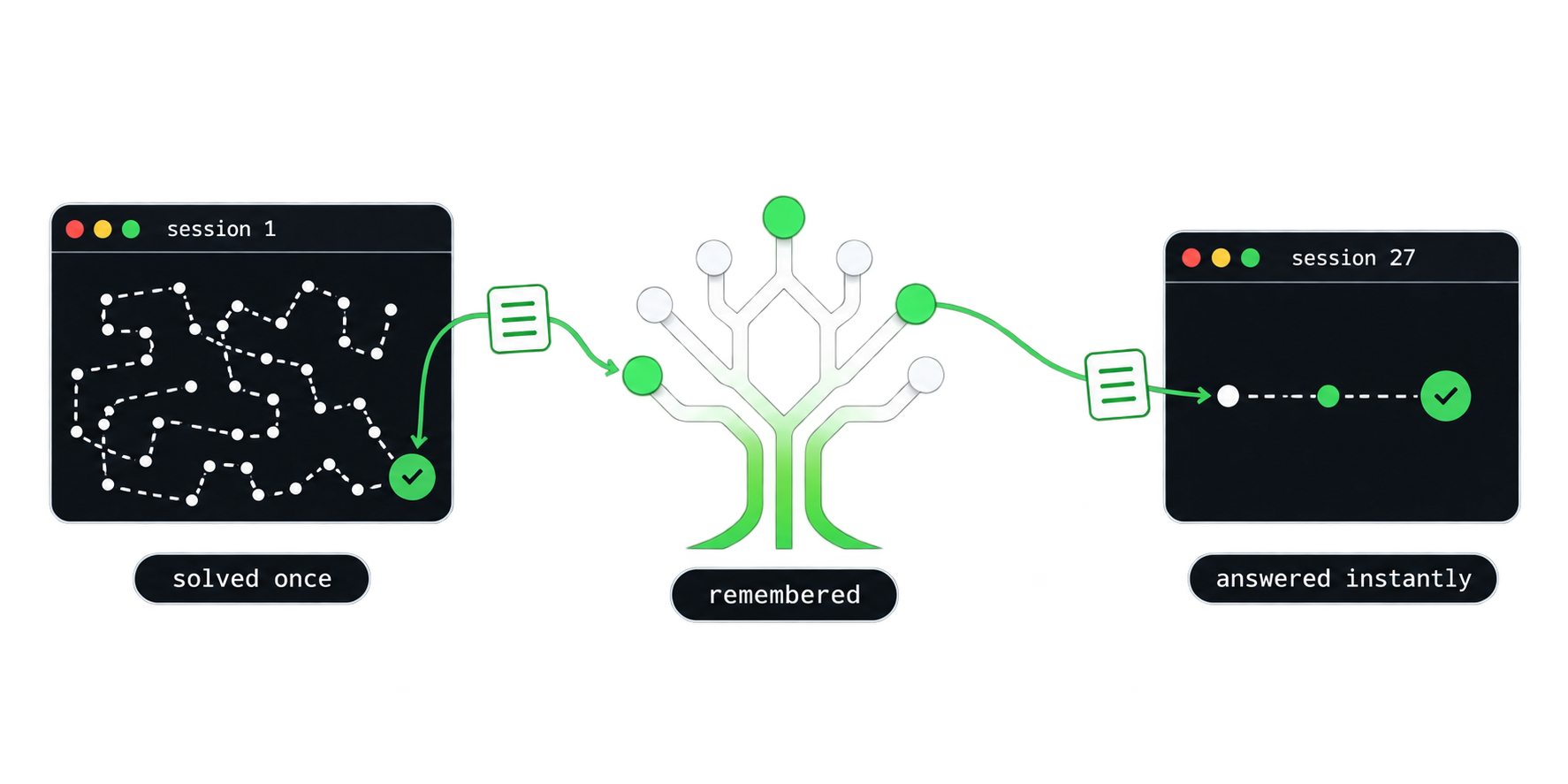
TeamGraph is persistent memory for coding agents. Your agent writes down what it learns — the fix, the gotcha, the decision and why. Next time it hits the same thing, TeamGraph hands back the answer before it starts over. The agent spends a moment checking it still holds, then moves on.

Fewer tokens per session Sub-second recall The same answer every time
teamgraph · solved once, remembered LOCAL DAEMON
How TeamGraph works: an agent solves a problem once, saves the learning, and recalls it instantly the next time
Solve → Save → Recall → Verify → Reuse
73%Right answers about your own code, up from 27%
0%Made-up answers, down from 27%
49%Fewer tokens on solved problems
40%Faster answers, warm recall in a fraction of a second
STOP SOLVING THE SAME PROBLEM TWICE

A problem solved once stays solved.

Without a memory, every session starts from zero: the same bug in a slightly different file gets re-investigated and re-derived. TeamGraph closes the loop — recall before you reinvent.

Without TeamGraphbug → investigate → fix → forgotten → (again, next week)
With TeamGraphbug → recall → check → done
The payoffno whole turns of reasoning for a problem already solved once
On Claude Code, recall happens without being asked: the plugin looks up every prompt and hands the agent a close note when there is one.
TWO MEMORIES IN ONE

Personal memory. Then team memory.

On its own, an agent's memory is what one agent learned. TeamGraph lets a whole team's agents share one memory — every fix, gotcha and decision, pooled and kept in sync.

01 THE MEMORY ENGINE

A verified semantic cache

A local binary and daemon keep your memory in a single SQLite file. Every note is embedded with BGE-M3; a lookup finds the closest node and runs a verify step that refuses to hallucinate a match.

  • STRONG, WEAK or MISS — never a false certainty
  • Content-addressed: the same insight, written twice, is one node
  • A graph viewer to browse what the agent remembers
Explore the memory model
02 THE TEAM GRAPH

One shared, convergent graph

Point TeamGraph at a shared graph and notes sync both ways. Sync is a CRDT with strong eventual consistency — apply changes in any order, or twice, and every replica converges to the same graph.

  • Conflict-free merge: nodes and edges union, state is last-writer-wins
  • A note keeps every author and source after merge
  • Work offline; it reconciles when you reconnect
Explore the team graph
Same insight, one note. Every note is identified by a BLAKE3 hash of its content — title, body and keywords — so the same thing written by two people deduplicates to a single node across the whole team.
BROWSE YOUR MEMORY

Every memory,
and how it connects.

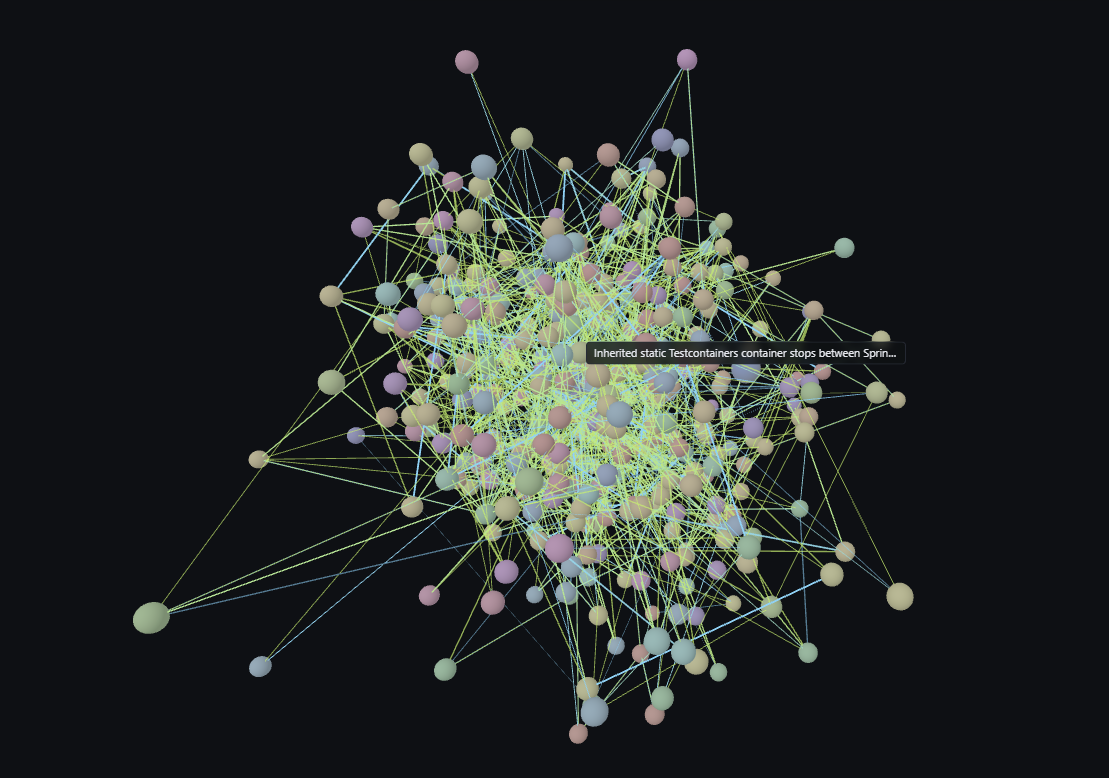
TeamGraph does not store memories as isolated items. Shared keywords and semantic similarity link them into a graph you can walk — from one note to the related ones. teamgraph view opens it in your browser.

Keyword edges Semantic edges Beam-search exploration Usage stats
How retrieval works
teamgraph view · graph explorer IN YOUR BROWSER
The TeamGraph viewer showing every memory as a node and the edges between related notes
Keyword & semantic edges · walked in both directions
WHY IT HELPS

More than a cache. Memory with judgment.

TeamGraph is designed to be trusted by an autonomous agent: it hands back a prior answer only when the evidence agrees, and it keeps history instead of overwriting it.

Refuses to hallucinate a match

A verify step combines semantic and lexical signals. A low-confidence vector hit does not become a confident answer — the agent gets a MISS, not a guess.

History that converges

Outdated notes are superseded or retired, not deleted. Tombstones propagate and a later restore brings a note back, so the whole team stays in step.

Private by choice

Every note is private, team or shared. Private notes are excluded from sync by construction, not by policy — mark one private and it never leaves your device.

WORKS WITH YOUR AGENT

Where your agents
already work.

Install the CLI and it copies the skills into every agent it finds, or add the plugin straight from your agent's marketplace. Anything that can run a command can use TeamGraph.

Claude CodePlugin from the marketplace · recall on every prompt
CodexPlugin from the marketplace
OpenCodeSkills, installed by the CLI
Gemini CLIIntegration
Claude DesktopMCP server
ChatGPTMCP server
Any agentAnything that can run a command
LET YOUR AGENTS KEEP WHAT THEY LEARN

Install once. Remember from then on.

One local binary, one SQLite file, and your agent stops solving the same problem twice.