query
"Have I solved this before? Give me the answer with high confidence." One verified node and its signals, in a fraction of a second warm.
cache lookup
Retrieval is the heart of TeamGraph: three orthogonal operations, each with a different shape, each tuned for a different question — the confident one-shot answer, the ranked shortlist, and the walk across related notes.
"Have I solved this before? Give me the answer with high confidence." One verified node and its signals, in a fraction of a second warm.
"Show me the top-k most relevant memories." Three candidate lists fused by reciprocal-rank fusion into one ranked set.
"Walk the graph from a topic and follow its edges." Beam search with diversity returns the visited nodes and the edges it traversed.
Suggest keywords for new text, drawn from the vocabulary your graph already uses — so tags stay consistent as the memory grows.
Every lookup shares two building blocks: the BGE-M3 embedding, and a verification stack that scores each candidate on multiple signals before it is allowed to answer.
Cosine similarity between the query and the candidate note's embedding, from 0 to 1. The first filter, and the one that catches paraphrases.
Trigram-Jaccard overlap between the query text and the note's title. It keeps a close-but-wrong vector hit from being promoted to STRONG.
An optional cross-encoder score for teams that want a stricter gate. Off by default; enable it with a cross-encoder model.
teamgraph query --explain lists every candidate the verifier scored, with its vector rank and signals, so you can see exactly why a question got the answer it did.Explore walks keyword and semantic edges in both directions with beam search and diversity — useful for "what does the graph know about topic X and the things around it?" rather than the single-best-match of query. teamgraph view opens the whole graph in your browser.
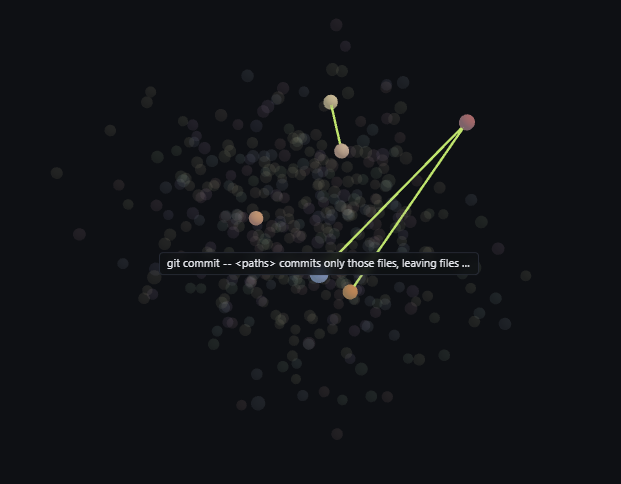
One verified answer, a ranked shortlist, or a walk across the graph — whichever your question needs.